I can't believe it's Week 8 already, it's going by sooooooooo fast! Before I jump in to this week's adventure I just wanted to take a minute to say Thank You to all the Deputies, Staff and Volunteers assisting with the Citizen's Academy! Everyone has been very friendly, willing to talk about their roles and answer all our questions. I have to admit this is turning out to be a better experience than I anticipated. Thank you!
Okay... on to Week 8 - Communications/Dispatch:
Captain John Messmer gave a brief introduction and then Sergeant Gammell gave a presentation before we ventured on to the dispatch floor and toured the facility.
The Johnson County Sheriff’s Office operates a Dispatch Center located at the County Communications Center in Olathe. JCSO Dispatch is the point of contact for emergency services (police, fire and ambulance) in the unincorporated areas of Johnson County and the cities of DeSoto, Edgerton, Fairway, Gardner, Lake Quivira, Merriam, Olathe, Mission, Roeland Park, Spring Hill, Westwood, as well as the Johnson County Park Police. In cases where fire or ambulance response is needed, JCSO immediately relays the call to the Johnson County Emergency Communications Center which is located in the same building making it convenient for both parties when an emergency call includes both police and medical. 80% of 911 calls are for police services. Deputy Walker said not to discount EMS/Fire though because the majority of their calls are life threatening.
The building the County Communications Center is located in opened in 2008. It was built to be able to withstand an F4 tornado. Which makes sense considering the importance of communication in an emergency. Because of this, EOC (Emergency Operations Center) stores their backup system at CCC. JCSO stores their back up system at the courthouse in Olathe.
Mission Statement:
The mission of the Communications Division of the Johnson County, Kansas Sheriff’s Office is the safety and welfare of the citizens and officers we serve. We receive emergency and non-emergency calls for service and relay them to the appropriate officer or agency so they can quickly and safely serve the needs of the public.
The goal of JCSO Dispatch is to provide a prompt response. Call Takers quickly obtain info. The primary information needed immediately is: 1) Location; 2) Nature of the emergency. Call Takers will communicate this information via their computer. A Dispatcher will then dispatch out the appropriate unit to the corresponding area. Calls are prioritized based on urgency. For example, a cat up a tree won't require quite as urgent a response as a possible homicide in progress. Considering the number of calls taken on a daily basis, it makes sense that calls have to prioritized for order of response by police.
Call Takers refer to those who... you guessed it ... answer the calls that come in to the dispatch center. Dispatchers take the information gained by the call takers to dispatch out the appropriate unit in their districts. Dispatchers mainly handle the radio traffic while the call takers handle the phone calls.
Dispatch is broken up in to districts: North (Merriam, Mission, Roeland Park, Fairway, Westwood), South (JCSO All Divisions, JC Park Police, Gardner, Lake Quivira, Spring Hill) and Olathe (All Divisions of their PD). Yep, Olathe is busy enough they need their own district. Generally a dispatcher has approximately 20 cars in the North District, 40 in the South District and 25 in Olathe that they dispatch to.
Role of JCSO Dispatch other than take calls and dispatch is to conduct computer inquiries (things such as warrant search, address of suspect (if crime), locate address of family/friends of suspect, pictures of suspect, etc), provide written record of call, relay info to other law enforcement agencies as needed.
Okay, how many of you knew that Call Takers and Dispatchers are actually Deputies? I didn't know that. I assumed they were civilians hired and trained to be Dispatchers. The reason why JCSO uses their deputies as call takers and dispatchers is because they can be cross trained which results in less burnout. If I recall from my EMS days, dispatchers' careers were typically 3-5 years and they were gone because of burnout. If a deputy experiences burnout they can transfer to a different division. Vice verse, if Dispatch needs additional call takers or dispatchers they can pull from the different divisions that have deputies who are cross trained for dispatch.
Staffing consists of 35 Deputies, 5 Sergeants, 2 Lieutenants and 1 Captain. Shifts consist of 7 Deputies on Midnights, 8 Deputies during the day and 9 Deputies in the evening. There is always at least 1 Supervisor on duty at all times. There are 5 support staff and we all know how important support staff are!
Call volume: JCSO has the 5th most volume of calls/dispatches out of 42 call centers in the 9 county area. Calls for service stats: 2009 - 56,642; 2010 - 86,968 (including Olathe which they took over in late 2009); 2011 - 85,170. These stats do not include self initiated activity by deputies. That activity results in additional support. In 2011 there were 231,274 reports for self initiated activity by deputies. (KCMO PD leads the area in calls for service followed by KCKS PD, OP PD, Independence PD then JCSO).
On to the tour... Lt. Walker and Lt. Johnson led the way.
Here are some photos from the dispatch floor (sorry they are a bit fuzzy!):
Master Deputy Marsh, Master Deputy Martinez and Master Deputy Jill Koch were on the floor with us to help answer any questions we had.

<><><>
</>
A console consists of 8 monitors. The first 2 monitors are for the telephone call and a map. Next 3 are the dispatch monitors where call takers share the information gained so that dispatch can get units en route. Next 2 monitors are support for databases. This is where they do research as needed. Final monitor displays the radio traffic JCSO listens to and transmits on. It seemed overwhelming but once I sat down at the console with the deputy it made sense. (Just a side note, some stations actually have a ninth monitor sitting above the others. Lenexa is on their own system and the additional monitor allows JCSO to view Lenexa's activity so that they are in the loop since Lenexa is located in JC and may occasionally need mutual aid from JCSO.)
The entire console can be raised or lowered to allow a Deputy to either sit or stand while working.


We actually got to sit down and do a ride a long so to speak with a deputy as they took calls. Deputy's rotate to a different responsibility every 4 hours. They are either a call taker, a primary dispatcher or a secondary dispatcher and they are assigned to a district. I sat with Deputy Paul Hayes. He has been with JCSO for approximately 5 years and went straight to dispatch from working in Detention. We only got 2 calls during the 45 minutes or so that I sat with him. That's probably because he was slow getting to the phone. Okay so that might have been partially or all my fault! He wasn't slow, I was talking too much. I asked a lot of questions which if you know me that's kind of odd. I'm usually pretty quiet and other than during that sit a long I don't think I spoke a peep all night. I actually jokingly hit Deputy Hayes on the arm at one point because we kept missing the calls (ie other deputies were picking up the calls too quick for us.). Guess it's a good thing he had a sense of humor. That wouldn't have been too good for me to end up in handcuffs because I hit him! Would have been a good story for the blog though huh?
The 2 calls we did take were fairly routine. One involved an alarm check on a building from a security firm that hadn't yet heard from the employees at a bank. The other call involved a mom who wanted a friend who was staying at the house to be escorted out by police because she felt he was doing drugs and was being a bad influence for her teenage son who had issues of his own. In both cases, Deputy Hayes input the information and then a dispatcher sent the appropriate unit out. I believe we were monitoring Olathe at the time. I asked Deputy Hayes if he ever followed up on calls to see what the outcome was. He indicated that unless it was a big or high profile situation he usually didn't. Too many calls to remember and not enough time to try to find out the outcome of each.
Deputies spend 15 weeks in training to become a call taker/dispatcher. That's 15 weeks in addition to the training they receive at the academy. Deputy Hayes indicated that even after 15 weeks you still feel a little overwhelmed but you get used to the pace and stress. Here is the training room where they spend those 15 weeks practicing in a controlled environment:
|
 |
| My group hanging out in the training room waiting to go over the case review. |
Part of the evening included reviewing a case study. Johnson County doesn't experience too many homicides but in 2009, a husband shot his wife in the back of the head. She would die at the scene from her injury. The homicide happened in Olathe. Sgt. Boden and Master Deputy Webb reviewed the case study with us.
We listened to the taped 911 calls. There were 5 different 911 calls that came in from people who either witnessed the shooting or learned first hand from the shooter of the incident. It was interesting to hear how calm the deputies were on the phone and how calm some of the callers were versus others who were clearly distraught. The shooting happened in the middle of the day which is probably why there were so many witnesses. Also because it was Olathe versus say KCMO or KCKS there were people willing to talk to the police. That's not racial profiling per se... just reality of socioeconomic areas.
We also got to hear the dispatchers communicating with officers who were working the scene and/or following leads to try to apprehend the shooter.
8 call takers/dispatchers and supervisors from Dispatch were involved on this one case. They were working to get a photo of the suspect, location of suspects family, friends etc to try and locate him, information on vehicle he was driving, etc to try and get as much information as possible out to the officers in the field. They also called the suspects phone carrier to see if they could ping the phone. You must get permission from the phone company unless the suspect calls 911. (Amazingly suspects are sometimes stupid enough to call 911 after committing a crime! Deputy Hayes told me of a call where a suspect did that after his family said they were going to call 911. He called 911 to see if they had called 911 on him! Um, that wasn't too bright because that allowed Deputy Hayes to ping his phone and relay his location to officers to arrest him.)
Other agencies were called in to help Olathe not only work the case but cover their city while their officers were working the case. Being able to connect multiple agencies on one system allowed for the mutual aid. Traffic units were called in to help secure a perimeter. Other agencies helped with the search including Park Police as one tip called in indicated the suspect might be on the stream way trail. KHP provided air support via a helicopter and plane.
After approximately 2.5 hours the suspect surrendered. Turns out a citizen spotted him and notified officers in the area who were able to take him in to custody. He was smoking a cigarette apparently trying to decide if he would turn himself in or commit suicide. (The case has gone to trial and the suspect was convicted.)
Here are pics from the "brains" of the dispatch center. I am not very techy but this is where the computer, phone and video are all backed up. All this is located below the dispatch floor so that wiring goes straight up to the floor. |
 |
| There is lots of open space to allow other agencies to store their back up systems at CCC if they want to. |
 |
| The server is now stored in one unit instead of multiple. Technology has advanced so much! |
NextGen 911 System will allow texts, pictures, etc to be shared with 911. The system will be Internet based and is currently being tested in Denver, Colorado. As systems become Internet based there will be less room needed to store backup systems. In a few years, the above storage unit might be more than is needed to store back up systems.
Just as important to the CCC is the electricity, room air/temperature, water supply, etc. 2 generators support the building.
 |
| One of the 2 generators that runs the building. |
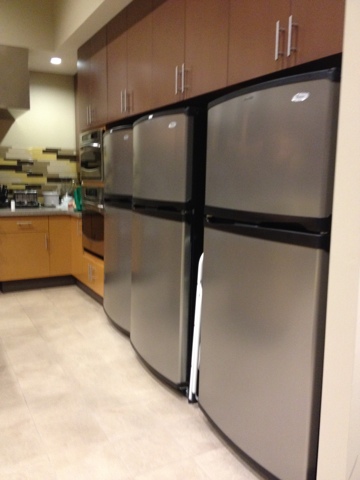
Remember I said the building was built to sustain a F4 Tornado? Well, there are times such as during bad weather that Deputies will spend the night at the CCC. JCSO tries to make it as convenient and comfortable for Deputies for those times when they need to stay in order to be at work for their next shift. Essentially they have "Living Quarters" in the building. Here are pics of the locker room and the break room:
 |
| The locker room is an "open" style rather than providing separate locker rooms for men and women. |
 |
| Deputy Walker led us on a tour through the facility including the locker room. |
 |
| This is their break room, I'm jealous!!! |
Thanks again to the Deputies that spent their evening showing us around the facility and allowing us to do a "ride a long" with them at their consoles!