Sunday, May 13, 2012

Week 11 - Introduction to and Tour of Crime Laboratory - JCSO Citizen's Academy

Week 11 - Introduction to and Tour of Crime Laboratory

SCIENCE - TRUTH - JUSTICE

The mission of the Johnson County Sheriff’s Office Criminalistics Laboratory is to aid in criminal investigations through timely, unbiased, high quality forensic services performed by highly trained experts using state-of the art instrumentation and scientific techniques.

The Johnson County Criminalistics Laboratory (JCCL) is located at 11890 S Sunset Drive
in Olathe.  They share the building with the Dispatch Center.  It is the only Crime Lab in the country that resides in a Lead Platinum Building.  It's a green building... ie very energy efficient. 

Just a snapshot of view from the stairwell.  Look it's a "green" building inside too!  Okay, bad joke...  but you will see green throughout the building.
In electricity alone, JCSO saves approximately $153,000 per year.  It utilizes a ground source heat pump and an energy recovery wheel.  Zero natural gas is pumped in to the building.  Lighting is limited to 1.4 watts per square foot with exception to special areas in the lab where more light is needed.  The building has 4 different levels of security depending on need for access. 
One of the many security pads visible in the lab that required a code and a finger swipe for entry access.
A brief history of the Crime Lab:  The JCCL, a division of the Johnson County Sheriff's Office, began operations in 1974 with five staff and offered services in photography, latent prints, crime scene processing, and firearms/toolmarks analysis. The services were expanded to include controlled substances, serology, and trace evidence. By the mid-1980's, the JCCL was considered a full-service crime lab with a total of nine staff.  In 1999, the JCCL received its first national accreditation in the disciplines of Biology/DNA, Controlled Substances, Latent Prints, Questioned Documents, and Firearms / Tool Marks. In 2004, the JCCL completed its second inspection and was accredited in Biology/DNA, Controlled Substances, Latent Prints, Trace (limited to Fire Debris) and Digital Evidence (limited to Video Forensics). The JCCL also began to become heavily involved in crime scene processing.  In 2010, the JCCL completed its third accreditation under a new, more stringent program; the ASCLD/LAB-International program. This new program is based on a set of Internationally recognized standards (ISO/IEC 17025:2005).

Gary Howell is the Laboratory Director and Allen Hamm is the Assistant Laboratory Director. Staffing levels at the JCCL have increased from five in 1974 to a current level of thirty-five. The JCCL currently routinely serves agencies in Johnson County and the surrounding area including: Olathe Police Department (PD), Olathe Fire Department, Mission PD, Shawnee PD, Shawnee Mission School District, Bonner Springs PD, Prairie Village PD, Merriam PD, Gardner PD, Lenexa PD, Leawood PD, Westwood PD, Overland Park PD, Roeland Park PD, Spring Hill PD, Lake Quivira PD, Fairway PD, Johnson County District Attorney, Johnson County Sheriff, Johnson County Park Patrol, Kansas State Fire Marshall, Kansas Highway Patrol, Kansas Bureau of Investigation, and Homeland Security/ICE.

The crime laboratory is accredited by the American Society of Crime Laboratory Directors/Laboratory Accreditation Board (ASCLD/LAB) since 1999.

The laboratory is actually 9 laboratories in 1 and consists of the following disciplines:
  • Biology
  • Controlled Substances
  • Crime Scene Investigation
  • Digital & Multimedia Evidence
  • Firearm & Toolmark
  • Latent Prints
  • Trace Evidence
  • Impression Evidence (Footwear/Tire Track)
  • Serial Number Restoration
After brief instructions not to touch anything, off we went to tour the different areas of the Lab.  Here are pictures and hopefully I got them all in their correct areas.  I probably shouldn't quit my day job, my photography skills leave a lot to be desired!  I couldn't take notes and while I like to think I have a good memory, I don't.  So to help explain each area I had a little help from my iPhone and I also borrowed information from the JCSO web page.  For more detailed information about each section of the Crime Lab visit their page at:  http://www.jocosheriff.org/. 


Biology

The JCCL Biology/DNA section examines a variety of evidentiary items for the presence of biological material such as blood, semen, urine, and other body fluids. The goal of DNA testing is to identify the source of the biological material.

The processing of evidentiary material to obtain a DNA profile is accomplished in four automated steps. First, DNA is extracted from a forensic sample. The extracted DNA is then quantified followed by the amplification of specific sequences (STRs) by a procedure called the Polymerase Chain Reaction (PCR). The amplified DNA is a separated by capillary electrophoresis using the 3500 Genetic Analyzer (This is the newest state of the art equipment available. This seems to be a common theme in the JCSO!) and analyzed with GeneMapper ID-X software.

The 3500 Genetic Analyzer:


Rob called this our CSI shot. View inside while test(s) are running:
Capable of running 8 tests at one time.


Here's an older analyzer.  It can only run 1 test at a time. Rob is running a test sample for us:


Analyzing the data:


Collecting the samples:  This is an old t-shirt that has blood, saliva, semen, sweat and urine on it. An alternate light source is used to screen for the evidence.  Once the stains are identified with the light they are circled so that testing and analysis can be done. Comforters, blankets, etc are very time consuming because of how many stains may be on it.  Rob states that the most stains he has seen on an item at one time was 200.  Blood and semen are the most common presumptive tests done. 


Beer bottles, soda pop cans, cigarette butts, etc are also great for collecting DNA because people slobber all over them!

A brief tour of the DNA section of the crime lab and some of the equipment used (in no particular order):


They have subzero freezers as well but I didn't catch a pic of one.

Examples of types of DNA samples that might be collected:


 What a DNA Profile looks like once analyzed:  Only identical twins will have identical profiles.


Thank you Rob for the tour through Biology/DNA!


Controlled Substances       

The JCCL Controlled Substances section tests a variety of evidentiary items for the presence of controlled substances and their synthetic precursors. Items tested include powders, liquids, plant material, pills, capsules, pipes and other various forms of paraphernalia.  Analysts routinely confirm substances such as marijuana, cocaine, methamphetamine, synthetic cannabinoids and bath salts, while also confirming lesser known designer drugs, steroids and final product and precursor components from suspected clandestine laboratories. Analysts rely on Kansas and Federal statutes to determine whether or not an encountered substance is controlled. While some substances found on the street may possess abuse potential, they may not be controlled and thus not subject to prosecution under the law.

Analysts in the section use state-of-the-art scientific methodology and instrumentation to positively confirm the presence of controlled substances. These techniques include presumptive color tests, thin-layer chromatography, gas chromatography-mass spectrometry, infrared spectroscopy and LC/MS/MS. Analysts also work closely with police investigative units and the District Attorney’s Office to provide research into new drugs of abuse for statute revisions and expedited testing for search warrants.

Equipment they use:


Cocaine, Methamphetamine, Poppie Seeds, Kaht, Mushrooms, Marijuana, K2, K3, K4, Spice, Bath Salts, etc are some examples of the vegetation the crime lab tests.  Most common abused pills are Oxycontin, Xanax and Vicodin. Don't trust what the pill says it is.  It's almost always been altered.  LSD is not as common as it used to be.  It's not as extravagant in design now.  Usually just white instead of different colors. 

Examples of some of the drugs tested in the lab:


This is the section of the Crime Lab that has been so helpful to me when I needed information about testing for Controlled Substances. I work for a company that provides drug testing for employers. When K2, Spice, etc hit the streets we had a tough time learning about it and how to test for it. I contacted JCSO and have been able to help keep my employer on top of the latest drug screening tests thanks to information JCSO has been able to share with me. 


Crime Scene Investigation


The JCCL Crime Scene Investigation section responds to and processes a vast spectrum of crime scenes including homicides and other death investigations, sexual assaults, battery cases, robberies, burglaries, etc. Crime scene processing can take place at a business or residence or in a vehicle, in which case it may be processed on site or at the JCCL. Even people may be processed as a crime scene when their body or clothing is housing evidence of a crime. Documentation of a crime scene utilizes photography, diagrams, and written reports. The section also utilizes a 3-D laser scanner to quickly capture millions of data points at a scene. This allows investigators to virtually walk through a scene without the potential of cross-contamination, and preserves the scene forever for future examinations or trials. Evidence collection includes all forms of biological specimens, trace evidence, firearms related evidence and trajectory information, footwear, tire tracks, bloodstains, fingerprints, and any and all materials of evidentiary value found at a crime scene. Advanced techniques such as chemical enhancement and detection of blood and alternate light source use for detection of biological fluids or other trace evidence may also be utilized.

Utilizing their photographs, diagrams, written reports, and the results of the evidence analysis, the members of CSI work with the various sections of the laboratory to reconstruct the events that transpired at the crime scene. They seek to answer the who, what, where, when, and how. Unlike on TV, typically the “why” is left to the investigating agency’s detectives.

In 2010, the JCCL Crime Scene Investigation became accredited for the first time at the JCCL under the ASCLD/LAB-International program. This makes the Johnson County Sheriff’s Office Criminalistics Laboratory among the first Sheriff’s Office organizations in the U.S. with an accredited Crime Scene Investigation section.

The CSI team consists of 2 civilians (these are the folks you see wearing a gray polo and black pants), a civilian supervisor and 3 deputies.  The team is a "jack of all trades".

Some of the things they use are Drying rooms, storage lockers, alternate light sources, visual imaging equipment.  I don't promise I got a pic of everything though!  A brief Tour and Equipment they use (in no particular order):
Retired equipment?  This was in a case outside the lab area.


Only the person in charge of the evidence can access it.  It's either locked in a locker or a room with only that person having the key.  An emergency over-ride can be done if the evidence is needed urgently and that person is on leave.


Evidence Lockers.
One of our participants was a little mouthy and almost got to find out if a human could fit inside!

View inside a photography lab:  (Bill really wanted the camera.  Good thing security's tight! :-) )


Not pictured is the Crime Scene 360 degree scanner and the software used with it.  It is the most current state of the art equipment available (again... a common theme for JCSO!).  It has approximately 37 million measurement points per scan when set on the medium setting.  Needless to say that is a great tool for crime scene reconstruction since it can create a 3D model of the crime scene.  It will never completely replace photography or on-site notes from investigators/officers.  It is used to enhance not replace investigators reconstruction.

The garage is big enough an 18 wheeler could fit inside.  View from inside the garage:


The garage has whiteboard that allows them to write on it while processing vehicles.
Mock Crime Scene:  Used for training.  The most recent Police Academy Class at JCCC was in last week practicing photography and will return next week to practice processing prints.  Other uses for the mock crime scene include practicing evidence collection and blood spatter analysis.


Not sure what happened to D.  Wonder if someone got a souvenir? JK!  I probably just missed it...


I didn't get the name of the deputy who toured us through CSI, sorry!  If anyone did, let me know and I will add her to the thank you list.

10/16/12 - Update:  Thanks to LinkedIn I finally learned the name of the deputy who toured us through this section.  Thank you to Master Deputy Tamara Holland for a very spirited discussion and tour! 

Digital & Multimedia Evidence
  
The JCCL Digital & Multimedia section currently processes digital and analog video evidence. Video analysis is the scientific examination, comparison and/or evaluation of video in legal matters. With the proliferation of video surveillance cameras in our society, it is rapidly becoming apparent the tools once thought of as crime “deterrents” are now becoming powerful resources in solving and prosecuting crimes.

The section can process images from analog (VHS, SVHS, Beta, 8 mm, etc.) and digital (cell phones, Digital Video Recorder, CD, DVD…etc.) sources. Examiners can also repair videotapes that have been damaged by fire, immersion, cutting or other physical damage. Advanced computer technologies are utilized to process these images to assist the law enforcement community. The section also offers advanced services such as comparative analysis, color correction, and reverse projection.

The section of the crime lab was developed with a Byrne Grant awarded in 2003 to purchase equipment and provide initial training in Video Analysis. In 2004, the video section successfully achieved ASCLD/LAB accreditation in digital evidence (video); at the time, it was the second section in the nation to receive accreditation status.

Brief Tour and Equipment they use:


In pic above Deputy Mark Phillips is demonstrating an example of video comparative analysis.

Some stuff that gets analyzed includes: Cell Phones, DVDs, VHS videos, etc.


For those of you young pups, those are DVDs and VHS tapes and players pictured above.

The goal of audio analysis is to attenuate noises for audio clarification.  The goal of video analysis is to clarify and deblur but not delete.  What you see on CSI tends to be fiction and not actual analysis performed.  (ie they delete images from the video or delete audio when in actuality things are clarified, not deleted.)  Video helps tell the story and establish a timeline.

This section also performs computer forensics.  Deleted information is never really gone and can be retrieved during analysis.  When a computer is received, a hash value (ie a fingerprint) is determined.  This helps establish that information has not been altered when the computer is received.  A hash value is determined at end of processing to confirm that no information was altered while in JCSO custody. Write block software is used during analysis to prevent writing data to the computer during analysis.  Cell phones are analyzed in the same manner as computers.

Floor in Audio/Video is anti-static . 
Some of the participants tried to scoot their feet to accumulate static to shock somebody with no luck!


Thank you Deputy Mark Phillips for the tour!

Firearm & Toolmark       

Firearms examination is a discipline of forensic science which has as its primary concern to determine if a cartridge case, bullet or other ammunition component was fired in a specific firearm. This is actually a form of toolmark examination where the firearm, because it is made of material harder than the ammunition components, acts as a tool to leave impressed or striated marks on the various ammunition components that come into contact with the firearm. To complete this, examiners test firearms to determine if they are functioning properly and obtain test fires by discharging the weapon into a large water tank. This provides exemplars from the firearm that may be compared to evidence from the scene. The examination is carried out using a specialized comparison microscope.

The same concept is used when performing toolmark examinations, where a toolmark is left at the scene and a suspected tool is collected. Test toolmarks are produced using softer metals (lead, copper, aluminum) and compared to toolmarks collected at the scene. Serial number restorations can be attempted because when a serial number is stamped into a piece of metal, the molecular structure of the metal changes forever. Even if the surface is ground away or filed down, the structure of the metal molecules that remain may have a “memory” of the original stamp. By applying different restoration methods, including acid etching and magnetic techniques, the original stamp can often times be at least partially restored.

The section has a firearms reference library of around 1700 firearms that were scheduled for destruction (they are donated from area law enforcement agencies). These guns provide the section with the opportunity to obtain parts for submitted guns that are broken or otherwise inoperative. It also provides the examiner a way to study the workings of a gun prior to handling a gun submitted as evidence, or serve as serial number structure reference and location if an evidence weapon’s number has been obliterated.  Gunshot residue and distance determination is the examination of clothing and other items for the presence of gunshot residue or shot patterns in an attempt to determine muzzle-to-object distance.

Miscellaneous pics (I have no idea why I took these but I am sure somebody knows!):


Bullet Identification and Toolmark Identification:


Examples of powder residue from different distances shot (these are actually in order):


Examining a bullet: side by side comparison.  CSI (the television shows) often show a gross comparison when in actuality, investigators are examining the fine microscopic imperfections.  Pictured below is a comparison done when using 2 scopes joined together to form an optical bridge.


Firearms accumulated by JCSO (approximately 1700 guns, knives and miscellaneous items):


Many of the miscellaneous items such as knives, swords and brass knuckles are donated by Leavenworth.

Water Tank:  The water tank prevents distortion of markings on a bullet. As much as we pleaded, Kevin wouldn't do a test fire in the tank for us!


Here's the shooting range where guns are test fired:  It is Sound proof and ricochet proof.  Firearms are fired in the range instead of the water tank when distance determinations are needed,for experimentation, when choreograph measurements are needed or to test fire a shotgun when the bullet is not useful.


And of course they have to be able to store all that ammunition somewhere!


Thanks for the tour Kevin!

Latent Prints

The JCCL Latent Print Section currently consists of six examiners to handle the requests of fingerprint analysis for the local law enforcement community. The techniques used in the development of latent prints range from traditional fingerprint powdering techniques and chemical processes such as superglue fuming, to advanced technologies such as fluorescent dye stains and alternate light sources.

Types of Prints and How they are analyzed:

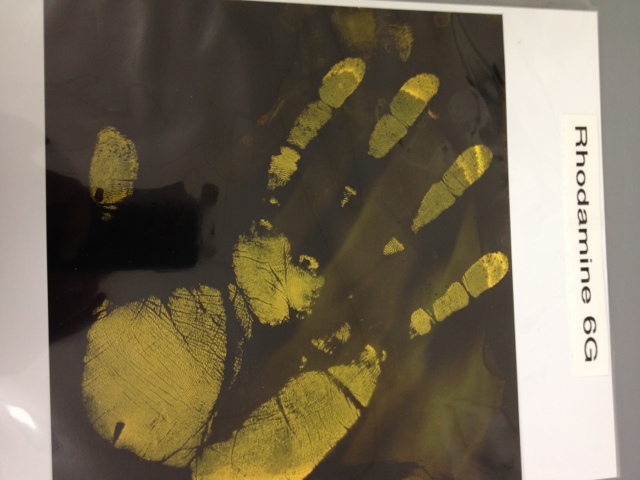
Finger prints come in three varieties: plastic, visible and latent. Plastic and visible are easy enough to see because they're left on soft surfaces like dust, or colored surfaces like blood smears and wet paint. Latent prints are more difficult to see because they're left on non-absorbent surfaces like wood and glass. One way to make those latent prints appear is to treat them with Super Glue. It's the cyanoacrylate ester in the Super Glue fumes that chemically reacts to the latent prints, making them visible to the naked eye.   The more contrast, the better the print. Photo shop may be used to help create more contrast. If a print can't be lifted it will be photographed and analyzed that way. Every print evaluated is looked at by 2 sets of eyes to try to eliminate mistakes.

Biggest question in court is "Are fingerprints unique?"  No 2 people have the same fingerprint.  Not even twins.  Guess I can't frame my twin for anything, dangit!  If someone doesn't have a viable fingerprint due to scarring, amputation, etc a palm print can be obtained or foot print.

Two questions to ask when determining how to process prints:  What is the print on (surface)? What is the print in (dust, blood, paint)?


Equipment they use: Humidity Chamber, Drying Chamber, Finger Print Dusting Stations, Super Glue Chambers.  Don't ask me which is which because I would just be guessing, Sorry!  The Super Glue Chamber is used in many of the different labs and was spotted several times.


One of the most valuable tools used in the latent print discipline are the use of the Automated Fingerprint Identification Systems (AFIS). The laboratory has the ability to search unknown latent prints through four separate AFIS databases. The Kansas AFIS allows for the search of a database of over 1 million known criminal offenders in the State of Kansas. The system allows the search of not only latent fingerprints but latent palm prints as well. In addition, latent prints can be searched through the Missouri AFIS database. The Integrated Automated Fingerprint Identification System (IAFIS) allows search capability of the Federal Bureau of Investigation’s fingerprint database. Due to the result of fingerprint searches through these systems within the past seventeen years, approximately 1,000 cases have been solved ranging from homicides to burglaries.

Footwear and Tire Track examinations (Impression Evidence) are also conducted by the section, and are similar to Latent Print examinations, except the evidence is a footwear or tire track impression.

Example of a footwear impression:


Thank you Troy for the tour of the finger print lab section!

Trace Evidence

The JCCL Trace Evidence section analyzes many different types of evidence including hairs, fibers and textiles, glass, paint, pressure-sensitive adhesive tape, fracture matching and condom lubricants.

Trace Evidence is defined as the small bits of matter that are transferred from one location/person, to another, whenever there is physical contact between two surfaces. Traditional trace disciplines include the microscopic comparison and classification of hairs and fibers and the chemical analysis of fibers, glass, paint and fire debris. Trace evidence encompasses an ever expanding body of evidence and the section frequently acts as a “catch-all” for any unknown item of evidence. A wide variety of polymers, plastics, chemicals, minerals, soils, wood and building materials, fiberglass and tapes can also be analyzed.

Technology in the field of trace evidence increases constantly and the Trace Evidence section has capabilities in the areas of digital photo documentation of microscopic examinations, color analysis of paint and fiber samples and elemental analysis of a wide variety of submitted samples that adds significant discrimination and association capabilities.

Equipment they use:  Microscopes!!!

JCSO has a Scanning Electron Microscope that is capable of magnifying things up to 100,000 x's.  Wow!!!

This is a magnification of a penny under a digital microscope. 
Did everyone know that the Lincoln Memorial is on the penny?


Things they analyze: Tape, hair, fibers, paint, etc.


Thank you Elizabeth for the tour of the Trace section of the lab!

Main theme of all sections of the Crime Lab is Documentation, Documentation, Documentation!

End of Tour.  Thank you to everyone (I didn't catch everyone's name, sorry!) who spent their evening touring us and answering questions!


Wednesday, May 9, 2012

Wait, it's Week 12 already??? - JCSO Citizen's Academy

I know, I know... I haven't posted about Week 11 - Introduction to and Tour of Crime Laboratory yet.  I will!  It will take me some time to get all the pictures and information together.  Look for that blog entry soon.  ...as we walked out of the Crime Lab last night it hit me that it's almost over.  It has gone by so fast!  And to think I almost didn't participate! 

The first night of the Citizen's Academy was on February 28, 2012.  I almost didn't participate because on February 23, 2012 my life was turned upside down.  I lost everything in a fire that night including one of my kitties (Cosmo) that had been part of my family for 14 years.  My other kitty (CJ) was badly burned and would face a painful recovery.  You hear about fires on TV and read about it in the news.  I even see them first hand as a Red Cross volunteer but you really don't appreciate the impact it has until you experience it.  It's devastating, overwhelming and it really does turn your life upside down. 


This is what I saw when I arrived at my apt complex February 23, 2012 (I was at training and unfortunately not home when the fire began.  My neighbor called me and told me to get home asap.)  The fire would destroy the entire building leaving 20 families looking for a new home.  I didn't know where to begin.  Lucky for me I had plenty of help in the form of donations, prayers and support.  I can't even begin to say how much my support system has meant to me.  However, all the support in the world is great but you still have the emotional toll.  How do you get back to "normal" after losing so much?  There were so many things to do and I was so emotionally drained.  I had one cat in the vet hospital and the other was still missing.  These were my kids.  If you have pets you know how much they are family.  I was lost without my boys.

CJ at the Vet Hospital Feb 24, 2012

Cosmo - January 2012
When Tuesday February 28 rolled around I really didn't know if I had the energy or even wanted to attend the Citizen's Academy.  However, I needed to somehow get back to a routine and decided I would attend the first night and then if it was too difficult I would inform JCSO that I was unable to attend.

I was quite distracted the first night of class. I kept receiving texts and phone calls from people who thought they found Cosmo.  I was trying to hold out hope that he had somehow escaped even though I knew in my heart he had not.  He was old and starting to show signs of deteriorating (no longer being able to jump up on high spaces, play etc like he used to).  I kept answering the phone and looking at the pictures.  My heart ached each time when I realized it wasn't him.  I would learn the next day that deceased animals had been pulled from the building.  Although I never viewed any of the animals I knew Cosmo was probably one of them.  He was a hider and likely hid under the bed when the fire started.  CJ was just the opposite.  He always runs to the door to greet visitors.

Attending the first night of class of the Citizen's Academy was actually the first "normal" thing I would do after the fire that didn't revolve around recovering from the fire.  Or was it?  Now that I look back I see how attending the academy actually helped me get on the road to recovery.  It gave me something to look forward to each week!

By March I was heading towards recovery.  I had already moved in to a new apartment and was accumulating furniture, clothes, etc.  I had returned to work and was beginning to feel like I was getting back in to a routine and then the unthinkable happened.  On March 6, 2012 I would attend class, head home and turn in for the night just like any other night but this would be anything but any other night.  At approximately 2am March 7, 2012 I was awakened by the sound of an alarm and neighbors yelling there is a fire and to get out of the building.  I couldn't believe it was happening again!  I had come to accept the 1st fire as part of life, stuff happens (the cause of the first fire is unknown but foul play is not suspected).  I never imagined it could happen again.  I got dressed, grabbed CJ, my purse, phone and keys and ran out the door down to my car (since it was not yet blocked in by police or fire) and drove just a few buildings down to my friends/neighbors.  When my neighbors heard the fire/police sirens they immediately looked out their window, realized it was my building and came outside looking for me.  They didn't have to ask me to come over, I was already on my way!  I couldn't bare to watch the fire so I hung out at their apartment while Lee went down to my building to see what was going on.  This fire would only damage 2 apartments.  My apartment would be spared but because it was right next to the unit where the fire originated, it would smell like smoke for weeks.  This fire would traumatize me more than the first.  I am not sure if it's because I wasn't home when the first fire started and therefore didn't experience being evacuated or if it's because the unthinkable happened again.  I have never really had nightmares as an adult but after fire #2, I would have nightmares for weeks. 

Despite fire #2 I would return to class the following week.  Glad I did because the hands on portion would begin.  It was a nice distraction from the stuff going on in my life!  Week 2 was a tour of the jail, Week 3 was training and an introduction to force. A few participants got to practice on the simulator.  Week 4 would give us all an opportunity to practice use of force techniques and simunition training.  Week 5 was an introduction to patrol and EVOC week.  Week 6 was warrants and introduction to the SERT unit.  It was cool to see all the equipment needed in those types of situations!  Week 7 was introduction to Civil and a tour of the Courthouse.  Week 8 was a tour of Dispatch and a "ride along" with a dispatcher/call taker.  Week 9 was Investigations where we got to review some of the cases worked on by JCSO.  Week 10 was K-9 officers including a demo by Nora and then of course last night was Week 11 - Introduction to and Tour of Crime Laboratory.  Many of us have also completed at least one ride along with a deputy in patrol. 

Sounds like we are all having a different experience on our ride alongs and because we are having different experiences, I am hoping to get a brief recap from all the participants so I can share it on my blog.  My first ride along was quiet with exception to the patrol car fail (see my entry 4/24/12 regarding my ride along).  I have to say though despite it being quiet, I really enjoyed my ride along.  Deputy Becker was friendly and professional.  I didn't feel like it was "work" to get her to engage in the conversation.  In fact, it felt like I was chatting with a friend.  When I wasn't asking questions, she was asking me questions.  The ride along wasn't supposed to be about me but by asking me questions she kept me engaged the entire shift.  One of the very first questions I asked was what a typical shift was like.  I really appreciated that she tried to show me a wide variety of activities so I could get a better feel for what a typical shift might entail instead of focusing on just traffic stops.  I look forward to my second ride along which will be with the same deputy but on a different shift since they will be changing shifts soon and I want to ride all 3 shifts.  Oh and because Deputy Becker had asked me questions, she knew when the car went up in smoke to make lite of it to put me at ease.  One can only take so much trauma but being able to joke and laugh about it definitely helps!

The Citizen's Academy has far exceeded my expectations!  I had no idea it would be so hands on.  What fun it was to drive the patrol cars on the EVOC course!  The tours of the different facilities has been great.  We have seen things many civilians in our community will never get to see unless they also participate in the citizen's academy (or become a guest of the JCSO - I'd recommend being a visitor rather than a guest!).  The deputies have all been friendly and answered all our questions.  I highly recommend to anyone interested in law enforcement as a career or just a general curiosity in what the job entails to attend a Citizen's Academy. 

I have a few more entries to post.  Range day is this weekend.  I won't be able to attend due to a previous engagement but if pictures are allowed, one of the participants has already volunteered to forward them to me (Thanks Bill!).  I will get to attend a make up session with the next academy class though.  That's very cool of JCSO to allow us to make up missed classes with the next class that goes through!  I also will post an entry about my 2nd ride along later this month (and 3rd which will be later this summer).  Next week is the dinner and final Q&A session.  We will learn more next week about what volunteer opportunities are available to us once we graduate the Academy.  I want to participate in a DUI check lane and will certainly post about that and any other volunteer opportunities that I might participate in.  I am disappointed that the Academy is almost over but am interested to learn how we can stay involved with JCSO.  I am really surprised to hear me say that.  You would think after having an encounter with a JCSO deputy a few years ago that I wouldn't want to have anything to do with the JCSO.  Instead the opposite is true.  It's amazing how treating someone with respect when they make a mistake can have such a positive impact!


Some of my fellow participants know about the fire and have been wondering how my kitty is doing.  He is doing well!  Thanks for all the support!  Here is a recent picture of him.  :)

CJ - May 7, 2012

Thursday, May 3, 2012

Week 10 Continued... Basic Gang Identification - JCSO Citizen's Academy

Week 10 Continued... Basic Gang Identification


(Editors note: I briefly stepped out of class and missed the very beginning of the presentation on Gang Identification. My fellow classmates kindly informed me that the first slide of the presentation said not to share or disclose any information from the presentation without consent from Major Reece or the Sheriff's Office. I touched base with Major Reece after the presentation and was given permission to share some of the information presented. Below is a brief recap of what was presented. I appreciate that the Sheriff's Office is allowing me to blog about my experience in the citizen's academy. I appreciate even more that they recognize it is my blog and ask me not to include information rather than instruct me not to include information. They very easily could have shot down the idea of the blog before it ever began. This is my first attempt at a blog and well I don't really know what I am doing so hopefully it has been at least half as interesting to read as it has been to participate!)


Major Daryl Reece presented on Gang Identification. 

Believe it or not, Johnson County does have gangs.   Although it's not a big problem like major cities may see, there are various gangs in JC.  According to the FBI there are 1.4 million gang members in the US and gang activity is increasing.  There are an estimated 200 gang members in Johnson County (based on a survey of inmates in custody the last 2 years).  The gangs are hybrids and are not well-organized or very active within the county.  Your little girl may not be as innocent as you believe...  many gangs now include women!

Major Reece discussed how one becomes a gang member and how one gets out of a gang.

We were shown tattoos and signs that are commonly used by gang members as well as the different names gangs go by.

Most gang members in JC come from a middle class family.   Reasons why someone might join a gang include:
  • Excitement
  • Love and Attention not getting at Home
  • Peer Pressure
  • Financial Benefit
  • Safety
  • Family Tradition
Combating gang activity begins in school.  Police in Olathe (where an estimated 60 percent of gang members reside in JC) train teachers and staff about what to look for to determine whether students are involved in a gang.

The gang culture swirls and spreads through rap music.  That doesn't mean that everyone who listens to rap music is in a gang, but be aware if your kids listen to rap.  Kids learn about and communicate with gangs often through rap music.

Johnson County has a Night Light program that may help reduce the risk of juveniles becoming involved in gangs. 
Night Light is a program operated by Juvenile Court Services.  Court Services Officers (CSOs) have the authority to visit juveniles at home, school, work, or elsewhere.  The program consists of CSOs teaming up with officers from local police departments and the sheriff’s office to conduct visits during nontraditional work hours which include:
  • Home visits
  • Employment visits
  • School visits
  • "Hot zone visits"
CSOs use the Night Light Program to:
  • meet parents,
  • to obtain information regarding a juvenile's probation, and
  • establish residence of juvenile.
If you would like to learn more about the Night Light Program, please follow this link:  http://courts.jocogov.org/cs_jnlp.aspx. 


Major Reece spoke briefly about Anti-Government Extremist Groups and important dates in their history. Did you know that the only law enforcement office Anti-Government Extremists recognize is the Sheriff's Office? It's because the Sheriff is elected rather than appointed.


And last but not least, Major Daryl Reece spoke about Personal Safety.

Car safety:  What's in the trunk of your car?  It's a good idea to keep an old phone charged up and in the trunk.  In the event you are pushed in to the trunk you can use the phone to call 911.  Remember, you may have upgraded to a new cell phone but you can still use your old cell phone to call 911.  It's also a good idea to keep a flashlight in your trunk.  Be aware of your settings particularly when alone, at night or in an unfamiliar area.  Keep your keys in your hands and ready to use as a weapon if needed.  Other items to consider carrying in your purse on your person are keys, $, whistle, flashlight and OC Spray (try to get 10% versus the smaller dose of 2%).  If approached by a stranger who wants your wallet, purse or keys throw them on the ground and run in the opposite direction.  Many times they want your $ and car, not you.  If your car breaks down it is best to stay with your car, call for help and use small signs that indicates you need help.  Don't use the big signs that obstruct your view or you may not see danger approaching.  Do not accept a ride from a stranger.  Don't program your home address in to your GPS system.  If you feel like you are being followed, don't drive directly home!  Make multiple turns or drive to your local police station.

Home safety:  Have an alarm system and link it to law enforcement so that if a break-in occurs they are dispatched to your residence.  Don't leave your home unlocked when you are not home.  If you are working in the backyard don't leave your front door unlocked or your garage open.  Make a video recording of your belongings so that if a burglary occurs you have something to show police and/or your insurance carrier (this is a good idea in the event of disaster as well... fire, flood, tornado, etc.).  Also a good idea to record serial numbers of items if available, again for identification purposes in the event they are stolen or destroyed.  Burglars don't want to attract attention to themselves so alarms and sensor lights are good to have to deter burglars.

CCW:  Concealed carry, or CCW (carrying a concealed weapon), refers to the practice of carrying a handgun or other weapon in public in a concealed manner, either on one's person or in proximity.  If you are going to CCW, get properly trained and know the law.

Active Shooter drill:  Active shooter drills should be performed in schools just as routine as fire and tornado drills but since they most likely aren't, teach your children what to do if an active shooter comes in to their school.  They should be aware of their surroundings and know where the closest exit is.  Evacuate if possible for best chance at survival.

Thank you Major Reece for the tips!  This wasn't listed as a topic but when Major Reece asked if we had been talked to about personal safety and we answered no, he spent a few minutes going over safety tips.

Week 10 Continued... K-9 Officers - JCSO Citizen's Academy

Week 10 Continued... K-9 Officers

Sgt Dan Fretz's K-9 partner is Figo, Master Deputy Mark Burn's K-9 partner is Ace and Deputy Travis Turner's K-9 partner is Nora.   Pictured below is Nora doing a brief demonstration.


JCSO uses German Shepherds as their K-9 partners.

I was curious as to what other breeds are used in law enforcement so I did a little research: Here is a list of breeds and the tasks they commonly perform:


  • Argentine Dogo (protect the officer, attack dog, sniff out bombs, sniff out drugs, sniff out food)
  • German Shepherd (protect the officer, attack dog, ground based tracking and air based tracking, locating human remains, locating drugs, locating EODs, locating evidence)
  • Dutch Shepherd (protect the officer, attack dog)
  • Belgian Malinois (protect the officer, attack dog, locating EODs)
  • Boxer (protect the officer, attack dog)
  • Labrador Retriever (sniff out bombs, sniff out drugs)
  • Doberman Pinscher (protect the officer, attack dog)
  • Springer Spaniel (sniff out bombs, sniff out drugs)
  • Bloodhound (Odor Specific ID, trackings, sniff out bombs, sniff out drugs, locating evidence)
  • Beagle (sniff out bombs, sniff out drugs, sniff out food)
  • Rottweiler (protect the officer, attack dog)
  • Giant Schnauzer (protect the officer, attack dog)
  • Bernese Mountain Dog (finds missing people)


  • JCSO deputies and their K-9 partners engage in training 6-8 hours weekly to keep up their skills.   Activities K-9 partners are used for include:   Obedience, Article Search, Building Search, Tracking, Aggression Control, and Narcotics Detection.   JCSO mainly uses dogs for narcotics detection and specificly for marijuana, methamphetamine, cocaine, heroin and ecstasy.   Most drug dogs aren't trained to detect ecstasy.   JCSO is unique in that they have included this training with their K-9 partners.

    Why use dogs in law enforcement?   Dogs sense of smell is 100 times greater than humans.  Dogs can run up to 32mph compared to humans that top out around 18mph.   Dogs hear 8 times better than humans.

    German commands are used mainly because of tradition but also because it's less likely a suspect can confuse the dog by trying to provide a command.   The dogs are trained on one syllable commands that are easy for the trainers to enunciate.

    K-9s and their partners certify as a team (handler/dog).   Average work life of a K-9 partner is 7 years.   JCSO purchased their partners using drug forfeiture $.   K-9s can cost $10K or more depending on their training.   It's not a good idea to cross train the dogs for different tasks or try to use them as pets.  The dogs do go home with their trainers but are kept separate from any pets in the home.   Laws prohibit teasing of or harming K-9 partners.

    K-9s have many different deployment opportunities:   Detention Centers, Community Corrections, Court House, School Searches, Dept of Revenue, DEA, Neighboring Sheriff's Offices and City Agencies.

    JCSO gets their K-9s from either Kansas Highway Patrol or Iron Heart.  When a K-9 partner retires they can either go home with the handler and become part of the handlers family or can be adopted out.

    Week 10 - Directed Patrol/Canine Officers; Basic Gang Identification - JCSO Citizen's Academy

    Week 10 - Directed Patrol/Canine Officers; Basic Gang Identification.

    As in previous posts, I am going to break the entries up so as not to be so cluttered.  First topic covered in Week 10 is Directed Patrol Unit. A separate entry will be for Canine (K-9) Officers and finally an entry will be specific to Gang Identification.

    Captain Baker kicked off the class with a brief introduction and then handed off to Sergeant Tom Reddin who put the new guy (Deputy Andy Blake) on the spot to give the presentation.  Assisting with the presentation were Master Deputy Mark Burns and Sergeant Dan Fretz.  (It was nice to finally meet you Mark! Guess I can't call you figment anymore... :))

    The primary goal of the Directed Patrol Unit is conducting criminal interdiction, investigations and arrests of those responsible for the use, possession, sale, manufacture, and distribution of illegal narcotics.  In addition, the Directed Patrol Unit provides Deputies to the Kansas City Drug Enforcement Administration High Intensity Drug Trafficking Area (HIDTA) Task Force and to the Drug Enforcement Administration Task Force.

    DPU consists of:
    • A Captain
    • A Lieutenant
    • A Sergeant
    • 9 Deputies, 2 are attached to a task force and 2 are attached to the canine teams
    • Administrative Aide
    DPU officers have take home cars because they are on call 24/7. 

    Responsibilities of DPU include Patrol, Education, County Wide Assistance with Narcotics (Interviews, Surveillance, Search Warrants, Knock & Talks, etc) and Vice Operations (Prostitution, Alcohol/Tobacco - sale, possession and distribution of).

    Johnson County sees approximately 3% of the illegal drugs coming in to the US.  Don't be deceived by that percentage! Here's a snapshot of what was seized in 2010 by the DEA and assisting agencies:

    Calendar Year
    Cocaine (kgs)
    Heroin (kgs)
    Marijuana (kgs)
    Methamphetamine (kgs)
    Hallucinogens (dosage units)
    2010
    29,179
    690
    722,476
    2,067
    2,578,935

    Do the math and you will see that even just 3% of the above is a lot of drugs!  Interstate 35 is a main corridor of drug trafficking because of it's span North/South across the US.  The reason why DPU focuses much of their effort on drug/criminal interdiction is because criminals are most vulnerable in transit and they are human so that means that even they have to sleep!  What better opportunity to catch a criminal than when they are most vulnerable?

    The Fourth Amendment to the Constitution is what governs law enforcements ability to search and seize drugs.  Officers must have Reasonable Suspicion or Probable Cause.  Exceptions to the search warrant requirement include:  Consent to Search; Plain View; Search Incident to Arrest; Auto Search; Stop and Frisk; Emergency; Inventory Search.  Many people will allow a Consent to Search either because they believe they are already caught or that they have hidden the drugs so well the officers won't find it. 

    JCSO works with DEA and the HIDTA task forces to try and identify narcotics and $ couriers through roadside investigations.  Communication is a key factor in cooperation between different agencies and communities in the effort to win the war against drugs. 

    Someone asked the question who to contact if we see or know of criminal activity and the response was to call the Sheriff's Office or 911. Here is a little more info directly from their web page:

    The Johnson County Sheriff’s Office welcomes any assistance by the public to aide in the investigation and disruption of criminal activity in the greater Johnson County area. If you have any knowledge of illegal activity involving narcotics, individuals, groups, or any information of interest you can contact the Johnson County Sheriff’s Office through our website, or call 913-715-5200 or through the tips hot line 1-816-474-TIPS (8477). All information will be treated as confidential and your identity will remain anonymous.

    Additional phone numbers:
    • DPU Contact number (913) 715-5584 (M-F)
    • On-call Officer (913) 715-5582 (24 hrs)


    Next up is K-9 Officers......