Week 11 - Introduction to and Tour of Crime Laboratory
SCIENCE - TRUTH - JUSTICE
The mission of the Johnson County Sheriff’s Office Criminalistics Laboratory is to aid in criminal
investigations through timely, unbiased, high quality forensic services performed by highly
trained experts using state-of the art instrumentation and scientific techniques.
The Johnson County Criminalistics Laboratory (JCCL) is located at 11890 S Sunset Drive
in Olathe. They share the building with the Dispatch Center. It is the only Crime Lab in the country that resides in a Lead Platinum Building. It's a green building... ie very energy efficient.
 |
| Just a snapshot of view from the stairwell. Look it's a "green" building inside too! Okay, bad joke... but you will see green throughout the building. |
In electricity alone, JCSO saves approximately $153,000 per year. It utilizes a ground source heat pump and an energy recovery wheel. Zero natural gas is pumped in to the building. Lighting is limited to 1.4 watts per square foot with exception to special areas in the lab where more light is needed. The building has 4 different levels of security depending on need for access.
 |
| One of the many security pads visible in the lab that required a code and a finger swipe for entry access. |
A brief history of the Crime Lab: The JCCL, a division of the Johnson County Sheriff's Office, began operations in 1974 with five staff and offered services in photography, latent prints, crime scene processing, and firearms/toolmarks analysis. The services were expanded to include controlled substances, serology, and trace evidence. By the mid-1980's, the JCCL was considered a full-service crime lab with a total of nine staff. In 1999, the JCCL received its first national accreditation in the disciplines of Biology/DNA, Controlled Substances, Latent Prints, Questioned Documents, and Firearms / Tool Marks. In 2004, the JCCL completed its second inspection and was accredited in Biology/DNA, Controlled Substances, Latent Prints, Trace (limited to Fire Debris) and Digital Evidence (limited to Video Forensics). The JCCL also began to become heavily involved in crime scene processing. In 2010, the JCCL completed its third accreditation under a new, more stringent program; the ASCLD/LAB-
International program. This new program is based on a set of Internationally recognized standards (ISO/IEC 17025:2005).
Gary Howell is the Laboratory Director and Allen Hamm is the
Assistant Laboratory Director. Staffing levels at the JCCL have increased from five in 1974 to a current level of thirty-five. The JCCL currently routinely serves agencies in Johnson County and the surrounding area including: Olathe Police Department (PD), Olathe Fire Department, Mission PD, Shawnee PD, Shawnee Mission School District, Bonner Springs PD, Prairie Village PD, Merriam PD, Gardner PD, Lenexa PD, Leawood PD, Westwood PD, Overland Park PD, Roeland Park PD, Spring Hill PD, Lake Quivira PD, Fairway PD, Johnson County District Attorney, Johnson County Sheriff, Johnson County Park Patrol, Kansas State Fire Marshall, Kansas Highway Patrol, Kansas Bureau of Investigation, and Homeland Security/ICE.
The crime laboratory is accredited by the American Society of Crime Laboratory Directors/Laboratory Accreditation Board (
ASCLD/LAB) since 1999.
The laboratory is actually 9 laboratories in 1 and consists of the following disciplines:
- Biology
- Controlled Substances
- Crime Scene Investigation
- Digital & Multimedia Evidence
- Firearm & Toolmark
- Latent Prints
- Trace Evidence
- Impression Evidence (Footwear/Tire Track)
- Serial Number Restoration
After brief instructions not to touch anything, off we went to tour the different areas of the Lab. Here are pictures and hopefully I got them all in their correct areas. I probably shouldn't quit my day job, my photography skills leave a lot to be desired! I couldn't take notes and while I like to think I have a good memory, I don't. So to help explain each area I had a little help from my iPhone and I also borrowed information from the JCSO web page. For more detailed information about each section of the Crime Lab visit their page at:
http://www.jocosheriff.org/.
The JCCL Biology/DNA section examines a variety of evidentiary items for the presence of biological material such as blood, semen, urine, and other body fluids. The goal of DNA testing is to identify the source of the biological material.
The processing of evidentiary material to obtain a DNA profile is accomplished in four automated steps. First, DNA is extracted from a forensic sample. The extracted DNA is then quantified followed by the amplification of specific sequences (STRs) by a procedure called the Polymerase Chain Reaction (PCR). The amplified DNA is a separated by capillary electrophoresis using the 3500 Genetic Analyzer (This is the newest state of the art equipment available. This seems to be a common theme in the JCSO!) and analyzed with GeneMapper ID-X software.
The 3500 Genetic Analyzer:


Rob called this our CSI shot. View inside while test(s) are running:
 |
| Capable of running 8 tests at one time. |
Here's an older analyzer. It can only run 1 test at a time. Rob is running a test sample for us:

Analyzing the data:


Collecting the samples: This is an old t-shirt that has blood, saliva, semen, sweat and urine on it. An alternate light source is used to screen for the evidence. Once the stains are identified with the light they are circled so that testing and analysis can be done. Comforters, blankets, etc are very time consuming because of how many stains may be on it. Rob states that the most stains he has seen on an item at one time was 200. Blood and semen are the most common presumptive tests done.


Beer bottles, soda pop cans, cigarette butts, etc are also great for collecting DNA because people slobber all over them!
A brief tour of the DNA section of the crime lab and some of the equipment used (in no particular order):


They have subzero freezers as well but I didn't catch a pic of one.
Examples of types of DNA samples that might be collected:


What a DNA Profile looks like once analyzed: Only identical twins will have identical profiles.


 Thank you Rob for the tour through Biology/DNA!
Controlled Substances
Thank you Rob for the tour through Biology/DNA!
Controlled Substances
The JCCL Controlled Substances section tests a variety of evidentiary items for the presence of controlled substances and their synthetic precursors. Items tested include powders, liquids, plant material, pills, capsules, pipes and other various forms of paraphernalia. Analysts routinely confirm substances such as marijuana, cocaine, methamphetamine, synthetic cannabinoids and bath salts, while also confirming lesser known designer drugs, steroids and final product and precursor components from suspected clandestine laboratories. Analysts rely on Kansas and Federal statutes to determine whether or not an encountered substance is controlled. While some substances found on the street may possess abuse potential, they may not be controlled and thus not subject to prosecution under the law.
Analysts in the section use state-of-the-art scientific methodology and instrumentation to positively confirm the presence of controlled substances. These techniques include presumptive color tests, thin-layer chromatography, gas chromatography-mass spectrometry, infrared spectroscopy and LC/MS/MS. Analysts also work closely with police investigative units and the District Attorney’s Office to provide research into new drugs of abuse for statute revisions and expedited testing for search warrants.
Equipment they use:


Cocaine, Methamphetamine, Poppie Seeds, Kaht, Mushrooms, Marijuana, K2, K3, K4, Spice, Bath Salts, etc are some examples of the vegetation the crime lab tests. Most common abused pills are Oxycontin, Xanax and Vicodin. Don't trust what the pill says it is. It's almost always been altered. LSD is not as common as it used to be. It's not as extravagant in design now. Usually just white instead of different colors.
Examples of some of the drugs tested in the lab:


 This is the section of the Crime Lab that has been so helpful to me when I needed information about testing for Controlled Substances. I work for a company that provides drug testing for employers. When K2, Spice, etc hit the streets we had a tough time learning about it and how to test for it. I contacted JCSO and have been able to help keep my employer on top of the latest drug screening tests thanks to information JCSO has been able to share with me.
Crime Scene Investigation
This is the section of the Crime Lab that has been so helpful to me when I needed information about testing for Controlled Substances. I work for a company that provides drug testing for employers. When K2, Spice, etc hit the streets we had a tough time learning about it and how to test for it. I contacted JCSO and have been able to help keep my employer on top of the latest drug screening tests thanks to information JCSO has been able to share with me.
Crime Scene Investigation

The JCCL Crime Scene Investigation section responds to and processes a vast spectrum of crime scenes including homicides and other death investigations, sexual assaults, battery cases, robberies, burglaries, etc. Crime scene processing can take place at a business or residence or in a vehicle, in which case it may be processed on site or at the JCCL. Even people may be processed as a crime scene when their body or clothing is housing evidence of a crime. Documentation of a crime scene utilizes photography, diagrams, and written reports. The section also utilizes a 3-D laser scanner to quickly capture millions of data points at a scene. This allows investigators to virtually walk through a scene without the potential of cross-contamination, and preserves the scene forever for future examinations or trials. Evidence collection includes all forms of biological specimens, trace evidence, firearms related evidence and trajectory information, footwear, tire tracks, bloodstains, fingerprints, and any and all materials of evidentiary value found at a crime scene. Advanced techniques such as chemical enhancement and detection of blood and alternate light source use for detection of biological fluids or other trace evidence may also be utilized.
Utilizing their photographs, diagrams, written reports, and the results of the evidence analysis, the members of CSI work with the various sections of the laboratory to reconstruct the events that transpired at the crime scene. They seek to answer the who, what, where, when, and how. Unlike on TV, typically the “why” is left to the investigating agency’s detectives.
In 2010, the JCCL Crime Scene Investigation became accredited for the first time at the JCCL under the ASCLD/LAB-
International program. This makes the Johnson County Sheriff’s Office Criminalistics Laboratory among the first Sheriff’s Office organizations in the U.S. with an accredited Crime Scene Investigation section.
The CSI team consists of 2 civilians (these are the folks you see wearing a gray polo and black pants), a civilian supervisor and 3 deputies. The team is a "jack of all trades".
Some of the things they use are Drying rooms, storage lockers, alternate light sources, visual imaging equipment. I don't promise I got a pic of everything though! A brief Tour and Equipment they use (in no particular order):
 |
| Retired equipment? This was in a case outside the lab area. |


Only the person in charge of the evidence can access it. It's either locked in a locker or a room with only that person having the key. An emergency over-ride can be done if the evidence is needed urgently and that person is on leave.
 |
Evidence Lockers.
One of our participants was a little mouthy and almost got to find out if a human could fit inside! |
View inside a photography lab: (Bill really wanted the camera. Good thing security's tight! :-) )


Not pictured is the Crime Scene 360 degree scanner and the software used with it. It is the most current state of the art equipment available (again... a common theme for JCSO!). It has approximately 37 million measurement points per scan when set on the medium setting. Needless to say that is a great tool for crime scene reconstruction since it can create a 3D model of the crime scene. It will never completely replace photography or on-site notes from investigators/officers. It is used to enhance not replace investigators reconstruction.
The garage is big enough an 18 wheeler could fit inside. View from inside the garage:


The garage has whiteboard that allows them to write on it while processing vehicles.
Mock Crime Scene: Used for training. The most recent Police Academy Class at JCCC was in last week practicing photography and will return next week to practice processing prints. Other uses for the mock crime scene include practicing evidence collection and blood spatter analysis.


Not sure what happened to D. Wonder if someone got a souvenir? JK! I probably just missed it...


 I didn't get the name of the deputy who toured us through CSI, sorry! If anyone did, let me know and I will add her to the thank you list.
10/16/12 - Update: Thanks to LinkedIn I finally learned the name of the deputy who toured us through this section. Thank you to Master Deputy Tamara Holland for a very spirited discussion and tour!
Digital & Multimedia Evidence
I didn't get the name of the deputy who toured us through CSI, sorry! If anyone did, let me know and I will add her to the thank you list.
10/16/12 - Update: Thanks to LinkedIn I finally learned the name of the deputy who toured us through this section. Thank you to Master Deputy Tamara Holland for a very spirited discussion and tour!
Digital & Multimedia Evidence
The JCCL Digital & Multimedia section currently processes digital and analog video evidence. Video analysis is the scientific examination, comparison and/or evaluation of video in legal matters. With the proliferation of video surveillance cameras in our society, it is rapidly becoming apparent the tools once thought of as crime “deterrents” are now becoming powerful resources in solving and prosecuting crimes.
The section can process images from analog (VHS, SVHS, Beta, 8 mm, etc.) and digital (cell phones, Digital Video Recorder, CD, DVD…etc.) sources. Examiners can also repair videotapes that have been damaged by fire, immersion, cutting or other physical damage. Advanced computer technologies are utilized to process these images to assist the law enforcement community. The section also offers advanced services such as comparative analysis, color correction, and reverse projection.
The section of the crime lab was developed with a Byrne Grant awarded in 2003 to purchase equipment and provide initial training in Video Analysis. In 2004, the video section successfully achieved ASCLD/LAB accreditation in digital evidence (video); at the time, it was the second section in the nation to receive accreditation status.
Brief Tour and Equipment they use:


In pic above Deputy Mark Phillips is demonstrating an example of video comparative analysis.
Some stuff that gets analyzed includes: Cell Phones, DVDs, VHS videos, etc.


For those of you young pups, those are DVDs and VHS tapes and players pictured above.
The goal of audio analysis is to attenuate noises for audio clarification. The goal of video analysis is to clarify and deblur but not delete. What you see on CSI tends to be fiction and not actual analysis performed. (ie they delete images from the video or delete audio when in actuality things are clarified, not deleted.) Video helps tell the story and establish a timeline.
This section also performs computer forensics. Deleted information is never really gone and can be retrieved during analysis. When a computer is received, a hash value (ie a fingerprint) is determined. This helps establish that information has not been altered when the computer is received. A hash value is determined at end of processing to confirm that no information was altered while in JCSO custody. Write block software is used during analysis to prevent writing data to the computer during analysis. Cell phones are analyzed in the same manner as computers.
 |
Floor in Audio/Video is anti-static .
Some of the participants tried to scoot their feet to accumulate static to shock somebody with no luck! |
Thank you Deputy Mark Phillips for the tour!
Firearm & Toolmark
Firearms examination is a discipline of forensic science which has as its primary concern to determine if a cartridge case, bullet or other ammunition component was fired in a specific firearm. This is actually a form of toolmark examination where the firearm, because it is made of material harder than the ammunition components, acts as a tool to leave impressed or striated marks on the various ammunition components that come into contact with the firearm. To complete this, examiners test firearms to determine if they are functioning properly and obtain test fires by discharging the weapon into a large water tank. This provides exemplars from the firearm that may be compared to evidence from the scene. The examination is carried out using a specialized comparison microscope.
The same concept is used when performing toolmark examinations, where a toolmark is left at the scene and a suspected tool is collected. Test toolmarks are produced using softer metals (lead, copper, aluminum) and compared to toolmarks collected at the scene. Serial number restorations can be attempted because when a serial number is stamped into a piece of metal, the molecular structure of the metal changes forever. Even if the surface is ground away or filed down, the structure of the metal molecules that remain may have a “memory” of the original stamp. By applying different restoration methods, including acid etching and magnetic techniques, the original stamp can often times be at least partially restored.
The section has a firearms reference library of around 1700 firearms that were scheduled for destruction (they are donated from area law enforcement agencies). These guns provide the section with the opportunity to obtain parts for submitted guns that are broken or otherwise inoperative. It also provides the examiner a way to study the workings of a gun prior to handling a gun submitted as evidence, or serve as serial number structure reference and location if an evidence weapon’s number has been obliterated. Gunshot residue and distance determination is the examination of clothing and other items for the presence of gunshot residue or shot patterns in an attempt to determine muzzle-to-object distance.
Miscellaneous pics (I have no idea why I took these but I am sure somebody knows!):


Bullet Identification and Toolmark Identification:


Examples of powder residue from different distances shot (these are actually in order):


Examining a bullet: side by side comparison. CSI (the television shows) often show a gross comparison when in actuality, investigators are examining the fine microscopic imperfections. Pictured below is a comparison done when using 2 scopes joined together to form an optical bridge.


Firearms accumulated by JCSO (approximately 1700 guns, knives and miscellaneous items):


Many of the miscellaneous items such as knives, swords and brass knuckles are donated by Leavenworth.
Water Tank: The water tank prevents distortion of markings on a bullet. As much as we pleaded, Kevin wouldn't do a test fire in the tank for us!


Here's the shooting range where guns are test fired: It is Sound proof and ricochet proof. Firearms are fired in the range instead of the water tank when distance determinations are needed,for experimentation, when choreograph measurements are needed or to test fire a shotgun when the bullet is not useful.


And of course they have to be able to store all that ammunition somewhere!


Thanks for the tour Kevin!
Latent Prints
The JCCL Latent Print Section currently consists of six examiners to handle the requests of fingerprint analysis for the local law enforcement community. The techniques used in the development of latent prints range from traditional fingerprint powdering techniques and chemical processes such as superglue fuming, to advanced technologies such as fluorescent dye stains and alternate light sources.
Types of Prints and How they are analyzed:
Finger prints come in three varieties:
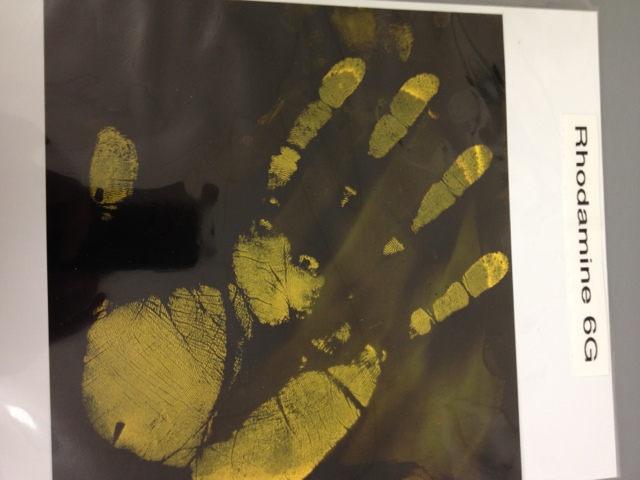
plastic, visible and latent. Plastic and visible are easy enough to see because they're left on soft surfaces like dust, or colored surfaces like blood smears and wet paint. Latent prints are more difficult to see because they're left on non-absorbent surfaces like wood and glass. One way to make those latent prints appear is to treat them with Super Glue. It's the cyanoacrylate ester in the Super Glue fumes that chemically reacts to the latent prints, making them visible to the naked eye. The more contrast, the better the print. Photo shop may be used to help create more contrast. If a print can't be lifted it will be photographed and analyzed that way. Every print evaluated is looked at by 2 sets of eyes to try to eliminate mistakes.
Biggest question in court is "Are fingerprints unique?" No 2 people have the same fingerprint. Not even twins.
Guess I can't frame my twin for anything, dangit! If someone doesn't have a viable fingerprint due to scarring, amputation, etc a palm print can be obtained or foot print.
Two questions to ask when determining how to process prints: What is the print on (surface)? What is the print in (dust, blood, paint)?


Equipment they use: Humidity Chamber, Drying Chamber, Finger Print Dusting Stations, Super Glue Chambers. Don't ask me which is which because I would just be guessing, Sorry! The Super Glue Chamber is used in many of the different labs and was spotted several times.


One of the most valuable tools used in the latent print discipline are the use of the Automated Fingerprint Identification Systems (AFIS). The laboratory has the ability to search unknown latent prints through four separate AFIS databases. The Kansas AFIS allows for the search of a database of over 1 million known criminal offenders in the State of Kansas. The system allows the search of not only latent fingerprints but latent palm prints as well. In addition, latent prints can be searched through the Missouri AFIS database. The Integrated Automated Fingerprint Identification System (IAFIS) allows search capability of the Federal Bureau of Investigation’s fingerprint database. Due to the result of fingerprint searches through these systems within the past seventeen years, approximately 1,000 cases have been solved ranging from homicides to burglaries.
Footwear and Tire Track examinations (Impression Evidence) are also conducted by the section, and are similar to Latent Print examinations, except the evidence is a footwear or tire track impression.
Example of a footwear impression:
 Thank you Troy for the tour of the finger print lab section!
Trace Evidence
Thank you Troy for the tour of the finger print lab section!
Trace Evidence
The JCCL Trace Evidence section analyzes many different types of evidence including hairs, fibers and textiles, glass, paint, pressure-sensitive adhesive tape, fracture matching and condom lubricants.
Trace Evidence is defined as the small bits of matter that are transferred from one location/person, to another, whenever there is physical contact between two surfaces. Traditional trace disciplines include the microscopic comparison and classification of hairs and fibers and the chemical analysis of fibers, glass, paint and fire debris. Trace evidence encompasses an ever expanding body of evidence and the section frequently acts as a “catch-all” for any unknown item of evidence. A wide variety of polymers, plastics, chemicals, minerals, soils, wood and building materials, fiberglass and tapes can also be analyzed.
Technology in the field of trace evidence increases constantly and the Trace Evidence section has capabilities in the areas of digital photo documentation of microscopic examinations, color analysis of paint and fiber samples and elemental analysis of a wide variety of submitted samples that adds significant discrimination and association capabilities.
Equipment they use: Microscopes!!!
JCSO has a Scanning Electron Microscope that is capable of magnifying things up to 100,000 x's. Wow!!!
 |
This is a magnification of a penny under a digital microscope.
Did everyone know that the Lincoln Memorial is on the penny? |


Things they analyze: Tape, hair, fibers, paint, etc.


 Thank you Elizabeth for the tour of the Trace section of the lab!
Main theme of all sections of the Crime Lab is Documentation, Documentation, Documentation!
End of Tour. Thank you to everyone (I didn't catch everyone's name, sorry!) who spent their evening touring us and answering questions!