Wednesday, April 18, 2012

Week 8 - Communications/Dispatch - JCSO Citizen's Academy

I can't believe it's Week 8 already, it's going by sooooooooo fast!  Before I jump in to this week's adventure I just wanted to take a minute to say Thank You to all the Deputies, Staff and Volunteers assisting with the Citizen's Academy!  Everyone has been very friendly, willing to talk about their roles and answer all our questions.  I have to admit this is turning out to be a better experience than I anticipated.  Thank you!

Okay... on to Week 8 - Communications/Dispatch:

Captain John Messmer gave a brief introduction and then Sergeant Gammell gave a presentation before we ventured on to the dispatch floor and toured the facility. 

The Johnson County Sheriff’s Office operates a Dispatch Center located at the County Communications Center in Olathe.   JCSO Dispatch is the point of contact for emergency services (police, fire and ambulance) in the unincorporated areas of Johnson County and the cities of DeSoto, Edgerton, Fairway, Gardner, Lake Quivira, Merriam, Olathe, Mission, Roeland Park, Spring Hill, Westwood, as well as the Johnson County Park Police.  In cases where fire or ambulance response is needed, JCSO immediately relays the call to the Johnson County Emergency Communications Center which is located in the same building making it convenient for both parties when an emergency call includes both police and medical.  80% of 911 calls are for police services.  Deputy Walker said not to discount EMS/Fire though because the majority of their calls are life threatening.

The building the County Communications Center is located in opened in 2008.  It was built to be able to withstand an F4 tornado.  Which makes sense considering the importance of communication in an emergency.  Because of this, EOC (Emergency Operations Center) stores their backup system at CCC.  JCSO stores their back up system at the courthouse in Olathe. 

Mission Statement:

The mission of the Communications Division of the Johnson County, Kansas Sheriff’s Office is the safety and welfare of the citizens and officers we serve. We receive emergency and non-emergency calls for service and relay them to the appropriate officer or agency so they can quickly and safely serve the needs of the public.

The goal of JCSO Dispatch is to provide a prompt response.  Call Takers quickly obtain info.  The primary information needed immediately is:  1) Location; 2) Nature of the emergency.  Call Takers will communicate this information via their computer.  A Dispatcher will then dispatch out the appropriate unit to the corresponding area.  Calls are prioritized based on urgency.  For example, a cat up a tree won't require quite as urgent a response as a possible homicide in progress.  Considering the number of calls taken on a daily basis, it makes sense that calls have to prioritized for order of response by police.

Call Takers refer to those who... you guessed it ... answer the calls that come in to the dispatch center. Dispatchers take the information gained by the call takers to dispatch out the appropriate unit  in their districts. Dispatchers mainly handle the radio traffic while the call takers handle the phone calls.

Dispatch is broken up in to districts:  North (Merriam, Mission, Roeland Park, Fairway, Westwood), South (JCSO All Divisions, JC Park Police, Gardner, Lake Quivira, Spring Hill) and Olathe (All Divisions of their PD).   Yep, Olathe is busy enough they need their own district.  Generally a dispatcher has approximately 20 cars in the North District, 40 in the South District and 25 in Olathe that they dispatch to.  

Role of JCSO Dispatch other than take calls and dispatch is to conduct computer inquiries (things such as warrant search, address of suspect (if crime), locate address of family/friends of suspect, pictures of suspect, etc), provide written record of call, relay info to other law enforcement agencies as needed.

Okay, how many of you knew that Call Takers and Dispatchers are actually Deputies? I didn't know that. I assumed they were civilians hired and trained to be Dispatchers.  The reason why JCSO uses their deputies as call takers and dispatchers is because they can be cross trained which results in less burnout.  If I recall from my EMS days, dispatchers' careers were typically 3-5 years and they were gone because of burnout.  If a deputy experiences burnout they can transfer to a different division.  Vice verse, if Dispatch needs additional call takers or dispatchers they can pull from the different divisions that have deputies who are cross trained for dispatch.

Staffing consists of 35 Deputies, 5 Sergeants, 2 Lieutenants and 1 Captain.  Shifts consist of 7 Deputies on Midnights, 8 Deputies during the day and 9 Deputies in the evening.  There is always at least 1 Supervisor on duty at all times.  There are 5 support staff and we all know how important support staff are!

Call volume:  JCSO has the 5th most volume of calls/dispatches out of 42 call centers in the 9 county area.  Calls for service stats:  2009 - 56,642; 2010 - 86,968 (including Olathe which they took over in late 2009); 2011 - 85,170.  These stats do not include self initiated activity by deputies.  That activity results in additional support.  In 2011 there were 231,274 reports for self initiated activity by deputies.  (KCMO PD leads the area in calls for service followed by KCKS PD, OP PD, Independence PD then JCSO).

On to the tour... Lt. Walker and Lt. Johnson led the way.

Here are some photos from the dispatch floor (sorry they are a bit fuzzy!): 


Master Deputy Marsh, Master Deputy Martinez and Master Deputy Jill Koch were on the floor with us to help answer any questions we had.


<><><>
</>
A console consists of 8 monitors.  The first 2 monitors are for the telephone call and a map. Next 3 are the dispatch monitors where call takers share the information gained so that dispatch can get units en route. Next 2 monitors are support for databases. This is where they do research as needed.   Final monitor displays the radio traffic JCSO listens to and transmits on. It seemed overwhelming but once I sat down at the console with the deputy it made sense. (Just a side note, some stations actually have a ninth monitor sitting above the others. Lenexa is on their own system and the additional monitor allows JCSO to view Lenexa's activity so that they are in the loop since Lenexa is located in JC and may occasionally need mutual aid from JCSO.)

The entire console can be raised or lowered to allow a Deputy to either sit or stand while working.


We actually got to sit down and do a ride a long so to speak with a deputy as they took calls.  Deputy's rotate to a different responsibility every 4 hours.  They are either a call taker, a primary dispatcher or a secondary dispatcher and they are assigned to a district.  I sat with Deputy Paul Hayes.  He has been with JCSO for approximately 5 years and went straight to dispatch from working in Detention.  We only got 2 calls during the 45 minutes or so that I sat with him.  That's probably because he was slow getting to the phone.  Okay so that might have been partially or all my fault!   He wasn't slow, I was talking too much.  I asked a lot of questions which if you know me that's kind of odd.   I'm usually pretty quiet and other than during that sit a long I don't think I spoke a peep all night.  I actually jokingly hit Deputy Hayes on the arm at one point because we kept missing the calls (ie other deputies were picking up the calls too quick for us.).  Guess it's a good thing he had a sense of humor.  That wouldn't have been too good for me to end up in handcuffs because I hit him!  Would have been a good story for the blog though huh?

The 2 calls we did take were fairly routine.  One involved an alarm check on a building from a security firm that hadn't yet heard from the employees at a bank.  The other call involved a mom who wanted a friend who was staying at the house to be escorted out by police because she felt he was doing drugs and was being a bad influence for her teenage son who had issues of his own.  In both cases, Deputy Hayes input the information and then a dispatcher sent the appropriate unit out.  I believe we were monitoring Olathe at the time.  I asked Deputy Hayes if he ever followed up on calls to see what the outcome was.  He indicated that unless it was a big or high profile situation he usually didn't.  Too many calls to remember and not enough time to try to find out the outcome of each. 

Deputies spend 15 weeks in training to become a call taker/dispatcher.  That's 15 weeks in addition to the training they receive at the academy. Deputy Hayes indicated that even after 15 weeks you still feel a little overwhelmed but you get used to the pace and stress. Here is the training room where they spend those 15 weeks practicing in a controlled environment:


My group hanging out in the training room waiting to go over the case review.


Part of the evening included reviewing a case study.  Johnson County doesn't experience too many homicides but in 2009, a husband shot his wife in the back of the head.  She would die at the scene from her injury.  The homicide happened in Olathe.  Sgt. Boden and Master Deputy Webb reviewed the case study with us.
We listened to the taped 911 calls.  There were 5 different 911 calls that came in from people who either witnessed the shooting or learned first hand from the shooter of the incident.  It was interesting to hear how calm the deputies were on the phone and how calm some of the callers were versus others who were clearly distraught.  The shooting happened in the middle of the day which is probably why there were so many witnesses.  Also because it was Olathe versus say KCMO or KCKS there were people willing to talk to the police.  That's not racial profiling per se... just reality of socioeconomic areas.
We also got to hear the dispatchers communicating with officers who were working the scene and/or following leads to try to apprehend the shooter. 

8 call takers/dispatchers and supervisors from Dispatch were involved on this one case. They were working to get a photo of the suspect, location of suspects family, friends etc to try and locate him, information on vehicle he was driving, etc to try and get as much information as possible out to the officers in the field.  They also called the suspects phone carrier to see if they could ping the phone.  You must get permission from the phone company unless the suspect calls 911.  (Amazingly suspects are sometimes stupid enough to call 911 after committing a crime!  Deputy Hayes told me of a call where a suspect did that after his family said they were going to call 911.  He called 911 to see if they had called 911 on him!  Um, that wasn't too bright because that allowed Deputy Hayes to ping his phone and relay his location to officers to arrest him.) 

Other agencies were called in to help Olathe not only work the case but cover their city while their officers were working the case.  Being able to connect multiple agencies on one system allowed for the mutual aid.  Traffic units were called in to help secure a perimeter.  Other agencies helped with the search including Park Police as one tip called in indicated the suspect might be on the stream way trail.  KHP provided air support via a helicopter and plane.

After approximately 2.5 hours the suspect surrendered.  Turns out a citizen spotted him and notified officers in the area who were able to take him in to custody.  He was smoking a cigarette apparently trying to decide if he would turn himself in or commit suicide.  (The case has gone to trial and the suspect was convicted.)


Here are pics from the "brains" of the dispatch center.  I am not very techy but this is where the computer, phone and video are all backed up.  All this is located below the dispatch floor so that wiring goes straight up to the floor.

There is lots of open space to allow other agencies to store their back up systems at CCC if they want to.


The server is now stored in one unit instead of multiple. Technology has advanced so much!
NextGen 911 System will allow texts, pictures, etc to be shared with 911. The system will be Internet based and is currently being tested in Denver, Colorado.  As systems become Internet based there will be less room needed to store backup systems.  In a few years, the above storage unit might be more than is needed to store back up systems.


Just as important to the CCC is the electricity, room air/temperature, water supply, etc.  2 generators support the building.

One of the 2 generators that runs the building.


Remember I said the building was built to sustain a F4 Tornado?  Well, there are times such as during bad weather that Deputies will spend the night at the CCC.  JCSO tries to make it as convenient and comfortable for Deputies for those times when they need to stay in order to be at work for their next shift.  Essentially they have "Living Quarters" in the building.  Here are pics of the locker room and the break room:

The locker room is an "open" style rather than providing separate locker rooms for men and women.


Deputy Walker led us on a tour through the facility including the locker room.

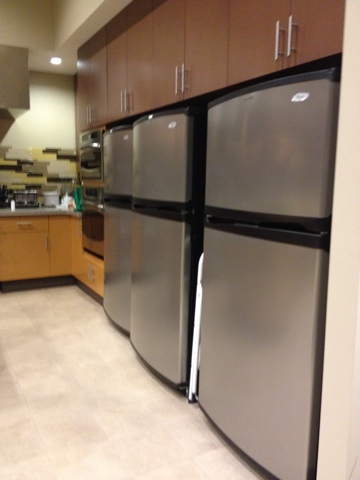
This is their break room, I'm jealous!!!


Thanks again to the Deputies that spent their evening showing us around the facility and allowing us to do a "ride a long" with them at their consoles!

Wednesday, April 11, 2012

Week 7 - Civil Division - JCSO Citizen's Academy

Captain Mike Raunig kicked off this portion of class by providing a brief background of the Civil/Collections Division and what deputies assigned to the unit do.  Lieutenant Rick Newson provided additional background information prior to Sergeant Brian Deer's detailed presentation.

Not all deputies have patrol experience.  Because deputies assigned to the Civil/Collections Division are out and about all over the county they are sometimes needed to back up patrol or other agencies.  (if you see a JCSO patrol car in the northern tier of the county they are likely either from Civil or Warrants Division) to help deputies assigned to Civil they are now going through additional training to introduce them to patrol.  It's a 5 week hands on program that orients them to patrol procedures.  All deputies within the Civil/Collections Division will complete the training this year. 

The Civil Division is assigned to serve Civil Court documents issued from the various courts of Johnson County.  These Courts would include District Court, Magistrate Court, Probate Court, and Juvenile Court.  Civil process is also received from other counties within the State of Kansas as well as Out-of-State district courts. 

Civil Papers are NOT warrants and do not require an arrest.  They are official Court documents notifying persons of civil action being taken by one party against another.  The document usually requires the person being served to take some type of action or answer to the courts regarding a specific matter within a given time frame.  Deputies are given a who, what & when guideline to follow to help them determine how to serve papers.

Evolution Circle for Civil Process:  Plaintiff files suit with the court & the suit goes to the court clerk; clerk sends suit to the Sheriff for service; after service the Sheriff's Office files a return of service with the court clerk; the clerk records the information for the Courts and the Plaintiff is notified.

The purpose of Collections is to carry out duties according to statutes that give the Sheriff authority to collect monies or property on delinquent taxes, insufficient funds from a worthless check and to enforce the laws with in the state of Kansas regarding vehicle registration.  2 Deputies are tasked with these responsibilities. 

Approximately 60,000 papers are served yearly.  The Sheriff's Office fee to serve these papers?  $5.00!  Needless to say it's not exactly a revenue producer for the county.  The fee will be going up to $10 in 2012 and then up again to $15 in 2013.  It doesn't even begin to cover the costs incurred while serving papers.

12 deputies are assigned to the Civil/Collections Division.  2 are dedicated to evictions.  2 to Collections with the remaining deputies handling the other papers.  2 training officers are dedicated to the Civil/Collections Division.  Deputies go through a 12 week program to learn how to deliver papers safely and in a respectful manner.  Deputies recognize that many times they encounter someone who is at a low point in their life and being served paperwork is not making life easier.  Evictions and Protection Orders are the most difficult for deputies to serve (ie difficult on the deputy as well as the individual being served). 

Sergeant Deer gave a very detailed presentation with statistics, the Evolution Circle for Civil Process, etc.  I didn't write down much because he indicated we could have a copy of the presentation.  Once I have that I may update this entry with more information.  So, if you're a stats person check back here for more info.  If you're not a stats person,  well don't worry about checking back for the update.  :)  (Note:  I received a copy of the presentation and have updated some of the stats as well as provided the evolution circle.) 

Here are just a few stats from the presentation:

In 2011, 58,948 papers were received by JCSO for service of which 40.208 were served which equates to a 68% service rate.  (Service means either the papers were handed to the individual on the notice or left at the residence with someone over the age of 14.  If an individual refuses service, the deputy just has to leave the papers at the residence.  They don't have to physically hand the papers to the individual.)  2010 - 60,729 papers received, 42,166 served for a 69.6% service rate.  2009 - 63,941 received, 44,151 served for a 69% service rate.

Evictions:  In 2011, 3009 Eviction Papers were served which is up from 2764 in 2010.  3108 evictions were served in 2009 and 3455 in 2008.  The economy and housing crisis were likely the reasons why the numbers fluctuated so much over the last few years.  A video was shown of an example of an eviction where the individuals had vacated the premises and left the property a complete disaster.  It is not uncommon for people to be angry about an eviction and leave the property in an unlivable condition.  Most evictions are not that dramatic though and the property is left in reparable condition for the next tenants to move in.  For a description of the Eviction Process click this link:  http://www.jocosheriff.org/civil/Evic_Process.pdf.

Protection from Abuse and Protection from Stalking Orders are what we often think of as Restraining Orders.  These are either Emergency, Temporary or Final.  These are the only orders that other law enforcement agencies can help serve or execute and it's typically because it's urgent and additional help is needed to get them served quickly.  2289 PFA's filed in JC in 2011, 2470 filed in 2010 and 2591 filed in 2009. 1808 PFS's filed in 2011, 1620 filed in 2010, 1799 filed in 2009.

The Collections Unit is responsible for Vehicle Registration Enforcement and Insufficient Funds collection.  In 2011, $309,556.47 was collected on Vehicle Registration Violations for the Treasurer’s office.  $83,337.40 was collected on Insufficient Funds and returned to the Treasurer’s office.   Deputies from Collections also collect delinquent taxes from Mid-March through early October from the previous tax year.  $1,075,731.14 was collected in 2011, $1,482,047.83 in 2010 and $816,961.75 in 2009.

One of the opportunities for volunteers in the Sheriff's office is to assist the Civil/Collections Division.  Currently 5 volunteers help out a few hours a day on a regular basis resulting in a savings of $18,906.00 for the Division in 2011 (1027.50 hours donated by volunteers).  Why do I have a feeling the different divisions are going to be fighting for volunteers at the conclusion of the academy??? 


--------------------------------------------------------------------------------------------------------------------------------------------------------------------------------------------------------------------------------------------------------------------------------------------------------------------------------------------------------


Okay, I know you are wondering, "What could possibly be scarier than jail?"   Well for me, this portion of the academy was the scariest.   Jail didn't bother me because... well... it didn't feel real.   I have never been arrested.   Yeah, I get pulled over a lot and my friends call me a cop magnet but generally I just have silly traffic issues, not something that would get me arrested.

If you have been reading my posts you may have caught that I have had an interaction with a JCSO deputy.  I had a traffic issue but there was a little more to it than that.  When I got pulled over I was terrified.  I had the "deer in the headlights" look because I was thinking worst case scenario... that I was going to be arrested!  I had an outstanding civil issue and wouldn't you know it, I got pulled over for a traffic issue by the same deputy who was tasked with getting me to take care of that civil issue.  When I saw the deputy's name tag all I could say was "Oh crap!".  I didn't understand the difference between a civil issue and criminal.  When the deputy explained to me what I needed to do to correct the situation I was relieved because then I understood I wasn't getting arrested.

I didn't get my issue resolved right away and the deputy stayed in contact with me until I did. There were some days that I wasn't very receptive to the deputy's phone call and didn't exactly hide it.   Despite my attitude, not one time was the deputy rude to me, not one time!   I was impressed by the deputy's calm demeanor and friendliness.  I got that issue resolved and was glad to make the phone call to the deputy to say "take me off your list!".  I was disappointed to have to leave that as a message; that was one time I actually wanted to talk to the deputy!  :-)

What that deputy doesn't know may surprise her but that mistake bothered me.   It bothered me so much that I had to do something so that I wouldn't repeat it.  Someone once told me, "It's not the mistake that defines you, but how you respond to it."  I wasn't going to let that mistake define me.  And since only 2 people other than me and the deputy know about it (don't ask, I'm not telling!), it couldn't by itself define me but it would change the path I was on.  Had the interaction with the deputy been a negative one I don't know if the outcome would have been the same.  It also helped that I was routinely running in to that deputy after the issue had been resolved.  Kind of like when you're speeding and you see a cop you feel compelled to slow down... well seeing the deputy served as a reminder to keep moving forward and not repeat history.  I won't go in to all the details but since that mistake one of the positive changes in my life is that I have become involved in volunteering. 

Volunteering has enriched my life so much!  Not only do I get to help people but I have been helped more than words can describe.  I went to Joplin to assist after the tornado last year.  I have been to numerous fires in KC this year to assist families with basic needs.  I spend time at a local animal shelter.  All these things have shaped who I am today.  And thank goodness for that because I was struck with my own tragedy not too long ago.  I recently was affected by a fire.  Had that happened a few years ago I would have thought it was the end of the world.  But because it happened this year I knew it wasn't.  I have an incredible support system in place that has been a tremendous help to me from family to friends to coworkers and all the volunteers I work with.  Yeah some days are hard but I know I will get through it because I am a stronger person than I was a few years ago. 

I continue to run in to that deputy fairly regularly.  We have the same morning coffee habit.  I used to hate running in to her!  I would turn bright red with embarrassment whenever she said "Good Morning" to me.  But I wasn't going to change my morning routine just to avoid her.  Now I can't help but grin when I see her.  She may not know how that interaction a few years ago shaped my life, but I do........  

I don't know if I will pursue volunteer activities with the Sheriff's Office once the academy is over as that wasn't my intention for attending the academy but I will keep an open mind about it.  If any of my fellow classmates are reading this I hope you will consider volunteering for the Sheriff's Office if you don't currently volunteer somewhere.  I can't even begin to explain how much volunteering has impacted my life! 

Week 7 - Court Security & Tour of Courthouse - JCSO Citizen's Academy

Lieutenant Becky Barton, Master Deputy Carl Alvano and Deputy Lucas Eimers gave a spirited discussion of Courthouse history as well as JCSO's role in providing courthouse security and led us on a tour.  For the Division's mission statement and chain of command click here:  http://www.jocosheriff.org/index.aspx?page=100. 

A brief history of the courthouse:  The Courthouse is home to the County's district courts system, housing all of its court rooms and court services, the District Attorney's office, the law library and much of the Sheriff's operations. The Johnson County Courthouse stands at the corner of Santa Fe and Kansas Ave. in downtown Olathe, KS.  It was built in four phases (which are easily identifiable as you walk through the building and see the different floor and light configurations). In 1951, the original courthouse was demolished to make way for a more modern structure.  A second addition was added in 1954. Two more additions came along, the first in 1968 and the second, the eight story tower, was started in 1972 and completed in 1976.  Click this link if you would like to view a slide show of the history of the Courthouse: http://facilities.jocogov.org/buildings/Courthouse.htm. 

Court Security started with one deputy and now has 18 deputies assigned to the Division.  The role of deputies is to protect Judges and the Public who enter the courthouse doors.  In 2011, 589,661 individuals were screened by JCSO deputies.  Everyone except for Judges and court appointed JCSO deputies must go through screening.  In 2011, 0 illegal weapons were confiscated.  1139 warrant arrests were executed.  

Before setting off on our tour here are a few items deputies displayed that have been confiscated from individuals as they were screened coming in to the courthouse:


Pretty amazing that people try to bring this stuff in considering there are a number of signs on your way in that tell you these things are illegal and will be confiscated!

Picture of the entrance.  I am looking at it from the top of the stairs down but if you notice there are signs on the doors that tell you to be prepared to empty your pockets and that all illegal items such as guns and other weapons will be confiscated.


Lt. Barton talking about the history pictured on the walls.  To the right is another sign telling us what can and can't be brought in to the courthouse.  This pic is in the entry way before you get to the screening area.

Is it not obvious by now???

Although there haven't been many incidents in the JC Courthouse, the possibility always exists. In 1988 there was a murder-suicide outside the courthouse. There has been one suicide in the courthouse in a bathroom. Somebody apparently wasn't happy with the outcome of their court case....  The third floor of the courthouse is rumored to be haunted because of the suicide in the bathroom.

And now for a brief tour:  We started at the top and worked our way down!  Here are some pictures from the top of the courthouse:


I posted one of the above pictures on facebook while we were going through the tour and one of my smartaleck friends asked if I was trying to escape.  Funny!!!  Geez........ gotta love my friends!

Here's a few pics from inside some of the courtrooms:


Cameras aren't allowed in the courtrooms but you will notice cameras in the hallways to assist deputies with security.  Here is an archaic camera.  Most of the time you will just notice the black bubbles that have a camera hiding inside.  There are panic buttons in every courtroom.  Response time for help by additional deputies is within one minute.  Generally the Judges feel pretty safe.


On the seventh floor is a picture of Paul Revere (forgot to take a pic, sorry!) that Deputy Alvano swears the eyes follow him as he walks down the hall! 

The DA's reside on a few of the floors including 4&5.  Things can get tense on those floors.

4th floor is where the old jail used to be.  Here is a pic of the old recreation room.  It was pretty small.

The 3rd floor is rumored to be haunted because of a suicide in one of the bathrooms.  Declined to take a pic of the bathroom.  A picture of the ghost would have been cool though! 

The second floor is the main entrance for the public.  We enter through the South entrance and must pass through screening before going anywhere in the courthouse.  Metal detectors became part of the screening process in 1997.


Only court assigned JCSO deputies can carry weapons while in the courthouse.  All other law enforcement must lock their guns, etc in a locker when they are in the courthouse.

When prisoners are transported to the courthouse they are housed across the street and shuttled across via the underground tunnel.  This is for public safety as well as the individual(s) in custody.


Also on the second floor is the court clerk if you are lucky enough to need to file paperwork, etc. Courtrooms (usually civil such as small claims, evictions, etc.) and the "Goddess of Justice".

"Goddess of Justice" 
She used to be on the roof but resides inside full time now on the second floor just after you pass through screening. 
She gets a good deep cleaning once a year.

Here are some more pictures of the history depicted on the walls as you come in the south entrance prior to going in to screening:


Here are a few pictures from outside the courthouse on the south side where the public enters:


And that concludes our tour.  Thanks again to Lieutenant Becky Barton, Master Deputy Carl Alvano and Deputy Lucas Eimers!